Global Law Experts 2018
2018
At the “Global Law Experts 2018” Annual Awards, Fornari e Associati won the award as “White Collar Crime Law Firm of the Year” for Italy.
Global Law Experts 2019
2019
At the “Global Law Experts 2019” Annual Awards, Fornari e Associati won the award as “White Collar Crime Law Firm of the Year” for Italy, confirming the previous year’s success.
According to the magazine, Fornari e Associati “is able to guarantee its clients an integrated legal service also internationally, thanks to a widespread and consolidated network of collaborations, which includes the most prestigious international law firms”.
Giuseppe Fornari “has developed his experience and expertise mainly in the corporate criminal law, a subject for which he is a professional at the highest national level”.
Legal Community Tax Awards 2020
2020
Fornari e Associati is the Criminal Tax Law Firm of the Year.
An important recognition for our team and for each of its professionals, “Praised for their ability to understand and handle perfectly all the most delicate issues. The firm has advised and continues to advise, on criminal and tax aspects, the most important Italian and foreign companies”.
https://legalcommunity.it/evento/legalcommunity-tax-awards-2020/
Le Fonti Awards 2020
2020
At the Le Fonti Awards 2020 event, founding partner Giuseppe Fornari received the recognition as Lawyer of the Year in the Criminal Law category: “for having handled all the main criminal trials involving leading groups and company managers in the corporate, environmental, financial and tax fields; for being not only a respected lawyer, but a mentor, able to invest in young and brilliant associates, thus embodying the highest spirit of the legal profession”.
The list of winners in Affari & Finanza — La Repubblica.
Legalcommunity Forty Under 40 Awards 2020
2020
At the evening dedicated to young excellence in the legal sector, Fornari e Associati was awarded Criminal Law Team of the Year as a professional firm “with a strong under-40 presence, able to provide high-level advice in all the specific areas of criminal law”.
A fine recognition and a great satisfaction for our Firm.
https://legalcommunity.it/legalcommunity-forty-under-40-italy-awards-i-vincitori/
Below is the video of the evening
https://legalcommunity.it/video-legalcommunity-forty-under-40-awards-italy-2020/
Libro d’Oro 2020 — Italian excellence
2020
Our Firm is once again among the Italian centres of excellence selected by Le Fonti in the Libro d’Oro 2020.
A great satisfaction for our entire team, which continues to grow and to receive important recognitions in the field of white-collar and corporate criminal law.
Thanks to Le Fonti and congratulations to all the other firms and professionals who share with us the pleasure of this recognition, which we welcome with the words of Professor Paola Severino:
“Today the criminal lawyer must be a technician, an expert in financial statements and stock market listings; he must be able to handle technical and demanding subjects such as white-collar or environmental criminal law, he must keep pace with change and immerse himself in problems completely different from the traditional ones.
Think, for example, of cyber security, a highly topical and complex subject today: here the criminal lawyer must know the phenomenon thoroughly and study every detail of it. After that, it is essential to fit the phenomenon into the classic categories of law.
Multidisciplinarity is the element that distinguishes a good criminal lawyer today.”
Milano Finanza — The best corporate lawyers and law firms 2021
2021
Fornari e Associati and its founding partner Giuseppe Fornari were listed in the Elite category of the ranking I migliori avvocati e i migliori studi legali corporate 2021 (The best corporate lawyers and law firms 2021) published by Milano Finanza, alongside other leading names in criminal law assistance and advice.
The full volume is available at newsstands.
Sole 24 Ore — Statista
2021
Il Sole 24 Ore published the Statista special, now in its third edition, dedicated to the law firms of the year 2021.
Our firm was selected in the “Criminal Law” category.
Legalcommunity Energy Awards 2021
2021
A great recognition for our Firm, which, at the Legalcommunity evening dedicated to excellence in the legal market in the Energy sector, received the award as Law Firm of the Year, Criminal Law, with the following citation from the jury: “One of the most highly regarded firms in corporate criminal law, during the reference period it stood out for having assisted leading Italian energy companies in matters of strategic importance”.
Legalcommunity Forty under 40 Awards 2021
2021
Our partner Enrico Di Fiorino received the recognition as Lawyer of the Year, Criminal Law, at the Legalcommunity Forty under 40 Awards.
The award was granted by the jury with the following citation: “A partner born in 1986, Enrico Di Fiorino leads a team with a strong under-40 presence. Like his colleagues, he is able to provide high-level advice in all the specific areas of criminal law”.
All the winners of the evening here: https://lnkd.in/dfx4bYj
Sole 24 Ore — Statista
2022
This year too our firm is listed among the leading names in criminal law by Il Sole 24 Ore, in the research promoted by Statista.
We thank all the clients and professionals who recommended us, and who continue to place their trust in us.
Sole 24 Ore — Statista
2023
Il Sole 24 Ore, through the research promoted by Statista, once again confirms Fornari e Associati among the leading names in criminal law.
Our heartfelt thanks to all the clients and professionals who recommended us.
Legalcommunity Litigation Awards 2024
2024
Our founding partner Giuseppe Fornari won the Legalcommunity Litigation Awards in the category Lawyer of the Year — White Collar Crime. The award was granted by the jury with the following citation: “The lawyer is a highly successful criminal practitioner who advises numerous clients in Italy in particularly important cases with enormous media coverage due to the parties involved”.
Legalcommunity Forty Under 40 Awards 2025
2025
Our partner Emanuele Angiuli received the recognition as Lawyer of the Year — White Collar Crime at the FortyUnder40Awards 2025 promoted by Legalcommunity.it.
The award highlights the expertise Emanuele has developed in financial, corporate, tax and insolvency criminal law, also through the growth of the Firm’s office in Apulia, a point of reference for major corporate clients active in the region.
A result that confirms the solidity of the professional path begun by the firm founded by Giuseppe Fornari, and the contribution of the new generations to the growth of Fornari e Associati.
Legalcommunity Tax Awards 2025
2025
The Firm received the Legalcommunity Tax Awards 2025 in the category Law Firm of the Year — Criminal Tax: “The firm, which specialises in this area, was cited as a byword for reliability and expertise in criminal tax proceedings for important clients, both private individuals and companies”.
Law Firm of the Year 2026 — Ranking Professioni and Corriere della Sera
2026
Fornari e Associati is among the winners of the “Law Firm of the Year 2026 — Top Ranking” contest, promoted by Ranking Professioni in collaboration with Corriere della Sera.
The initiative, now in its third edition, selects each year the law firms that stand out for professional quality, reputation and positioning in the Italian legal market. The ranking was published in the pages of L’Economia del Corriere, within a special feature dedicated to the 200 outstanding law firms identified by the editorial team.
Among these, only 86 law firms — including Fornari e Associati — made it into the Top Ranking category, which represents the selection of the most prestigious professional firms. The assessment criteria defined by the scientific committee of Ranking Professioni-Corriere della Sera, chaired by Professor Umberto Frigelli of the Università Cattolica of Milan, were based on a multiplicity of parameters and on a multidisciplinary evaluation model:
“Turnover, number of operating offices, active clients in the firm’s own region and total clients, growth in turnover over the past year, increase in the number of partners, employees, collaborators and associates over the past year, number of citations in articles and specialist journals, number of books published by the firm’s partners, associates or collaborators. A very important area is the evaluation and enhancement of human resources, the attraction and retention of talent — a decisive factor in a market in which young recruits are declining and law firms compete to find new talented professionals. Another criterion of judgment falls within the sphere of innovation: the number of social media on which the firm is continuously active, the presence of part-time or full-time professional roles dedicated to human resources management, and the use of smart working”. (source: Corriere della Sera)
A recognition that bears witness to the commitment, expertise and quality of the work carried out every day by the entire Fornari e Associati team.
To read the full article click here
Fornari e Associati among “The Law Firms of the Year 2026”
2026
A recognition of the Firm’s track record in corporate criminal law
Fornari e Associati features in the ranking “Gli studi legali dell’anno 2026” (The Law Firms of the Year 2026), published by Il Sole 24 Ore in collaboration with Statista.
The mention confirms the Firm’s position among the leading players in corporate criminal law and highlights a professional path built on specialisation, continuity of activity and the trust of the market.
The full ranking is available on the Il Sole 24 Ore website.
MAG – Legalcommunity.it
13 January 2026
Our founding partner Giuseppe Fornari was interviewed by MAG – Legalcommunity.it on the evolution of the role of the corporate criminal lawyer and on the new phase of development undertaken by the Firm.
During the interview, it is highlighted how the criminal lawyer has today become a natural and integral presence in the life of companies, called upon not only to manage crises but increasingly to prevent them and to support management in strategic decision-making. This cultural shift has its roots in the introduction of Legislative Decree No. 231/2001 and in the evolving needs of the business world.
Within this framework lies the growth path of Fornari e Associati, already set in motion in recent years with the promotion to partner of Enrico Di Fiorino, Emanuele Angiuli, and Lorena Morrone, and destined to continue with the admission of new partners drawn from the Firm’s current team.
Alongside litigation activity, which remains the core of the profession, the Firm has progressively strengthened its expertise in compliance, organizational models, workplace health and safety, prevention of environmental crimes, and the management of criminal and reputational risks, including in extraordinary transactions.
From this evolution stems the project to flank the Firm with a structured network of of counsel in key areas such as M&A, environmental law, and tax law, with the aim of offering clients truly integrated and multidisciplinary assistance.
The dialogue with MAG also includes a reflection on the challenges posed by the expansion of artificial intelligence: a tool destined to have a profound impact on the legal profession, yet one that will not be able to replace the central role of the human factor in the relationship of trust with the client.
INTERVIEW:
FORNARI E ASSOCIATI, A NETWORK OF OF COUNSEL IN THE WORKS
What is the goal? To expand the Firm’s service offering and further integrate its white-collar crime core practice. Speaking to MAG, Giuseppe Fornari outlines the evolution of corporate criminal law, which is becoming less reactive and increasingly embedded in the day-to-day life of companies. Compliance, risk prevention, and support for strategic decision-making are taking on a central role.
In corporate criminal law, the era of purely reactive defence has long since come to an end. Today, the criminal lawyer is increasingly a central and integral figure in the life of companies: “although our primary role will always remain in the courtroom, the criminal lawyer is now called upon not only to manage crises, but to prevent them and, often, to help guide strategic decision-making.” It is from this awareness that the new phase of development of Fornari e Associati originates. Founded by lawyer Giuseppe Fornari, and recognised as one of the country’s leading criminal law boutiques, the firm is now looking to the future with a project aimed at complementing the firm with a structured network of of counsel professionals.
Today, the firm comprises approximately twenty professionals and four partners, the result of a deliberate choice made from the outset. “I decided to invest in young lawyers from the very beginning of their training, entrusting them with responsibility and promoting them to partners based on merit in the field, not on the clients or revenue they bring in. It is one of the things I am most proud of, after my son Gianmarco,” Fornari explains. This internal growth has led Enrico Di Fiorino, Lorena Morrone and Emanuele Angiulli to become partners, each with a distinct professional profile, and may in the future result in other members of the team joining the partnership. Fornari, firmly established among the leading figures in the field of business crime, describes himself as a “traditionalist criminal lawyer with an eye to the future”: deeply attached to courtroom advocacy and adversarial proceedings, yet, together with his partners, committed to expanding the firm’s focus beyond litigation to include compliance and legal awareness, areas that have become increasingly central for companies.
According to the founder of Fornari e Associati, this cultural shift inevitably dates back to 2001, with the introduction of Legislative Decree No. 231. “Organisational models have transformed criminal law. Today, the criminal lawyer is no longer perceived as a threat, but as a natural and necessary presence in corporate life.” Compliance programmes, ethical models, anti-corruption systems, delegation of functions, workplace safety and the prevention of environmental crimes have become structural elements, with a direct impact on companies’ legality ratings and their ability to do business.
This role now extends to extraordinary transactions as well. “We are increasingly involved in acquisitions: it is no longer just a matter of reviewing numbers and contracts, but of understanding what criminal and reputational risks a company carries with it. No one wants to buy a box that contains a virus,” Fornari observes. This awareness is particularly evident among directors and executives, who are increasingly attentive to the personal and corporate consequences of strategic decisions.
Today’s criminal lawyer therefore has a dual vocation: “advising managers and companies has become a daily activity, alongside what is — and will remain — our natural dimension, namely litigation, also in light of the legislature’s growing tendency to create new criminal offences.” Fornari does not shy away from criticising what he calls “over-criminalisation”: “In Italy, there is a tendency to think that every problem can be solved by introducing new crimes and increasing penalties. But that is not how crime is reduced.” True prevention, he argues, lies in concrete measures: real safety on construction sites, intelligent public policies, education, and targeted incentives for virtuous companies. “Installing an extra streetlight in a dark neighbourhood is often more effective than increasing penalties.”
Alongside the technical dimension, the human relationship remains central. “The trust that develops with a company director during criminal proceedings is comparable only to that between doctor and patient,” Fornari says. A relationship that often leads clients to seek advice beyond strictly criminal matters, recognising the criminal lawyer as a trusted and authoritative point of reference. It is also from this perspective that the idea emerged to go beyond traditional external collaborations. “Criminal lawyers increasingly work in close coordination with other business professionals, which naturally leads to considering new and more structured forms of collaboration.”
The firm’s plan for the coming years is clear: to complement the firm — which will remain a criminal law boutique — with a number of of counsel professionals integrated on a stable basis. “I do not intend to abandon the long-standing and successful professional relationships we already have, but rather to offer clients a more structured first level of response,” Fornari explains. The areas identified are those most frequently requested by clients: M&A, administrative and environmental law, and tax law, with the possibility of also including non-legal expertise, such as business economists or corporate advisors. The objective is to support companies in a comprehensive manner, from a preventive and strategic standpoint. The first integrations could take place as early as 2026–2027.
This model differs from more invasive merger or aggregation attempts that have often remained on paper: here, the autonomy of professionals is preserved within a shared framework of values, style and ethics. “Technical excellence is essential, but so is the way the profession is practised,” Fornari emphasises.
All of this fits into a broader vision of the legal profession shaped by more than thirty years of experience, beginning in the early 1990s during the Tangentopoli period and continuing with the opening of his first law firm in his early thirties. Today, Fornari e Associati is also a point of reference for younger generations, thanks to an intense mentorship programme and collaborations with student associations, particularly at Bocconi University.
Looking ahead, the challenge of artificial intelligence also looms large, which Fornari describes as “a historic revolution.” Yet the message is clear: technology and humanity must coexist. “The more technology advances, the more we must cultivate a new humanism. Those who believe they can rely solely on AI, neglecting human relationships, education and sensitivity, are bound to fail.” In corporate criminal law, where personal freedom and reputation are at stake, the human factor remains irreplaceable: “in the digital age, proximity to one’s client is essential; this is also why we have opened offices in Rome and Bari, to ensure clients have a point of reference throughout the country.” It is precisely on this balance between innovation and values that the future of the boutique will be played.
Le Figaro – Interpol
Our Enrico Di Fiorino interviewed in Le Figaro, 8 December 2025.
Interpol has historically played an extremely important role in effectively combating the most serious crimes at the international level. However, the international organisation, now composed of 196 member countries, is afflicted by serious problems that undermine international cooperation.
In the article, lawyers Pierre-Olivier Sur and Clara Gérard-Rodriguez of FTMS describe attempts at manipulation by China and Interpol’s current inability to prevent the abusive use of the Red Notice system.
Our Enrico Di Fiorino denounces another distortion of the procedure: “To avoid an official refusal of extradition by third countries, Russia – which is moreover excluded from the Council of Europe – sometimes refrains from submitting an extradition request, leaving the individuals concerned in a state of permanent uncertainty: they remain exposed to the risk of arrest abroad. This situation reveals the limits of a system founded on the good-faith cooperation of States and highlights the need for a deep and definitive reform of Interpol in order to protect the rule of law and fundamental rights.”
The risk is that of remaining in a perpetual limbo, constantly exposed to the danger of being arrested in any country – an arrest which in itself cannot be challenged – because of the Red Notice, but without any authority being able to intervene to restore the person’s liberty: neither the judicial authorities of individual countries, deprived in a unilateral and instrumental way of a case on which they could rule, nor Interpol’s CCF, which had increasingly relied on national decisions to delete Red Notices.
Global Law Expert 2025
2025
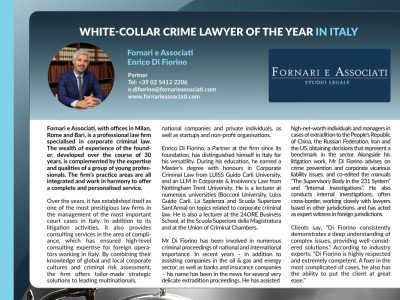
Our partner Enrico Di Fiorino was awarded at the Global Law Experts 2025 as “White-collar crime lawyer of the year in Italy”.
According to the jury: “Mr Di Fiorino has been involved in numerous criminal proceedings of national and international importance. In recent years — in addition to assisting companies in the oil & gas and energy sector, as well as banks and insurance companies — his name has been in the news for several very delicate extradition proceedings. He has assisted high-net-worth individuals and managers in cases of extradition to the People’s Republic of China, the Russian Federation, Iran and the US, obtaining decisions that represent a benchmark in the sector. Alongside his litigation work, Mr Di Fiorino advises on crime prevention and corporate vicarious liability issues, and co-edited the manuals “The Supervisory Body in the 231 System” and “Internal Investigations”.
He also conducts internal investigations, often cross-border, working closely with lawyers based in other jurisdictions, and has acted as expert witness in foreign jurisdictions. Clients say, “Di Fiorino consistently demonstrates a deep understanding of complex issues, providing well-considered solutions.” According to industry experts, “Di Fiorino is highly respected and extremely competent. A fixer in the most complicated of cases, he also has the ability to put the client at great ease.”
Enrico Di Fiorino mentioned in “China Targets” by International Consortium of Investigative Journalists (ICIJ)
Our partner Enrico Di Fiorino comments in the International Consortium of Investigative Journalists on how Chinese authorities allegedly misused Interpol to pursue political and financial targets abroad.
The article was originally published on 29 April 2025 and can be viewed here.
On a chilly afternoon in the spring of 2021, while awaiting an extradition hearing in Bordeaux, France, Businessman H. received an unexpected call from an old friend and business partner.
Jack Ma was on the line.
H. was surprised to hear from Ma, the tech titan and one of China’s richest men, according to a transcript of the call.
Ma said he was calling at the behest of Chinese authorities, who were seeking H.’s immediate return to China.
“Did they approach you?” H. asked.
“Mmh,” Ma acknowledged. “They said I’m the only one who can persuade you to return.”
A few weeks earlier, H. had been arrested by French authorities on the basis of a red notice, an alert circulated among police forces worldwide by Interpol, the international police organization that critics say is often misused by authoritarian regimes.
Ma, co-founder of the sprawling Alibaba retail and technology empire, had himself only recently reemerged into public view. He had disappeared for three months after making a scathing speech in which he criticized Chinese financial regulators. As a result, the government abruptly nixed the stock market debut of his Ant Group, a financial technology firm, and forced its restructuring. Ma told H. that top officials at China’s anti-graft agency approached him with a peculiar mission: persuade H. to return voluntarily from France, court records show.
Chinese authorities were trying to get H., a China-born naturalized citizen of Singapore, to testify in a case unrelated to anything in his red notice: a corruption case against a former vice public security minister named Sun Lijun, according to court records obtained by the International Consortium of Investigative Journalists and its partners Radio France and Le Monde on the condition that H.’s real name not be used.
H. declined to comment for this story; Ma didn’t respond to ICIJ’s requests for comment.
A prominent businessman in his own right, the 48-year-old H. owned a vineyard in Bordeaux in southwestern France and frequently appeared in Chinese tabloids beside his wife, Zhao Wei, a movie star turned business tycoon. Just a month before Ma’s call, French officers had arrested H. as he stepped off a private jet at the Bordeaux airport citing a red notice issued by Interpol against him at the request of Chinese prosecutors in the southern city of Dongguan.
The notice accused H. of money laundering and complicity in an embezzlement scandal involving Tuandai, a private lending company H. had invested in. It made no mention of the high-profile government case against the vice minister, Sun Lijun.
“They’re using the Dongguan case as a pretext,” H. told Ma. “If I explain clearly what happened with Sun Lijun, they won’t pursue me anymore. Is that what they assured you? Right now I don’t believe anyone.”
“I think you don’t have any other choice,” Ma said. “Now they’re giving you a chance. If you don’t come back, they’ll definitely destroy you.”
“… I understand. I’ll think about it,” H. replied, and hung up.
H.’s case is hardly isolated. A decade ago, Chinese President Xi Jinping began publicly calling for stepped-up international law enforcement action to track down what he called corrupt citizens abroad. Since then, a cross-border investigation led by ICIJ found that China has used red notices and other Interpol tools to target not only criminals, but also businesspeople with political connections like H., along with regime critics and members of persecuted religious minority groups seeking refuge overseas.
The case of H. and many others show how, despite attempts at reforming Interpol, the organization’s secretive processes and reluctance to hold system abusers publicly accountable remain a boon for authoritarian regimes. China does not appear to be among countries currently subject to Interpol corrective measures for alleged misuse of the organization’s system, ICIJ and its Slovenian media partner Oštro found.
The findings are part of ICIJ’s China Targets investigation, a collaboration of 43 media partners in 30 countries that exposes the mechanics of the Chinese government’s global repression campaign against its perceived enemies and the governments and international organizations that allow it. The investigation found that China’s misuse of Interpol is part of a well-organized effort to silence and coerce anyone that the Chinese Communist Party deems as a threat to its rule, including those no longer on Chinese soil. Chinese authorities also use surveillance, hacking, financial asset seizure and intimidation of targets’ relatives in China and other measures to neutralize regime critics beyond its borders.
The investigation is based on interviews with more than 100 targets of China’s transnational repression who now live in 23 countries, as well as secret video and audio recordings of police interrogations, confidential Chinese documents and other evidence.
Ted Bromund, a strategic studies specialist and expert witness in legal cases involving Interpol procedures, says Interpol has become central to China’s campaign of transnational repression, a vital “tool” to put pressure on targets abroad. In particular, China uses red notices “like a pin through a butterfly,” he said. “It holds someone down, locks them in place so they can’t get away.”
In a statement to ICIJ Liu Pengyu, a spokesperson for the Chinese Embassy in Washington, D.C., said that “the Chinese government strictly abides by international law and the sovereignty of other countries.” Liu did not address specific questions about China’s use of Interpol. China’s Public Security Ministry did not respond to ICIJ’s comment request.
‘A black box’
Interpol has no police force of its own. Instead, it draws on police data from democracies and autocratic regimes to compile massive databases that member nations use to share information on wanted criminals and to cooperate on cross-border crimes such as terrorism, human trafficking, financial crime and drug smuggling.
About a decade ago, after human rights advocates and news organizations including ICIJ exposed how Iran, Russia and other authoritarian regimes misused Interpol to round up political opponents and refugees, the organization announced what it said were sweeping reforms.
In 2016, it created the Notices and Diffusion Task Force, made up of lawyers, police officers and other specialists who screen red notices before authorizing their publication in Interpol’s databases. But the task force’s review is limited to information that is publicly available and what is already in Interpol’s databases, as well as data from the authorities who submit the notice requests. It doesn’t investigate the merits of a case and relies on the requesting government’s good faith to ensure information is both accurate and apolitical. If a red notice target doesn’t have much of a public profile, the task force likely will approve a request, lawyers representing suspects told ICIJ. “Politically motivated red notice requests can slip through,” said Charlie Magri, a lawyer who worked as a legal officer for the CCF oversight body.
As part of its reforms, the organization gave more powers and resources to the CCF. The commission — which meets four times a year — reviews, and may even revoke, Interpol’s notices if a subject demonstrates it violated Interpol’s apolitical mission or other rules.
But authoritarian governments, with legal systems under political control, continue to pose a special problem for Interpol, which, experts and human rights advocates say, seeks to navigate its rules while maintaining relationships with the member states who provide financial support.
Because most Interpol procedures are secret, determining whether a red notice is politically motivated or a legitimate attempt to catch a criminal is difficult, these advocates say.
“It’s like a black box,” said Ben Keith, a London-based human rights lawyer who has represented many Chinese nationals, including businesspeople wanted for fraud and Uyghurs accused of terrorism.
An Interpol spokesperson said in a statement to ICIJ that the organization “knows Red Notices are powerful tools for law enforcement cooperation and is fully aware of their potential impact on the individuals concerned, which is why we have robust – and continuously assessed and updated – processes for ensuring our systems are used appropriately.”
The spokesperson, however, said the task force’s original decision to authorize a red notice “can only be based on the information available at the time of publication.”
The targets
ICIJ and its media partners have spoken with eight of China’s red notice targets and reviewed extradition records, confidential CCF decisions and other documents concerning a total of nearly 50 suspects pursued by China through Interpol after the 2016 reforms.
Many suspects discovered they were wanted only after being stopped at a border control. Among the targets were wealthy businesspeople who said they were wanted for criticizing government policies; Uyghur rights advocates who said they had been falsely accused of terrorism after opposing Beijing’s oppression of minorities; a small-town politician who said he was blacklisted after exposing Communist Party corruption; and three entrepreneurs who said authorities were after them for being followers of the Falun Gong spiritual movement, which is banned in China. The most common pretext used by China to obtain a red notice is a financial crime, advocates say.
“If someone accuses someone of murder, there needs to be a body,” said Bromund, the Interpol critic, who is policy director of the Pursuit, a nongovernmental organization that opposes transnational repression. “If someone accuses someone of financial crimes, it is literally ones and zeros in the wrong ledger somewhere.”
Lawyers for red notice targets said they found a range of flaws common to Chinese-requested red notices, including discrepancies between arrest warrants and other documents and thin evidence to substantiate the allegations.
If someone accuses someone of murder, there needs to be a body. If someone accuses someone of financial crimes, it is literally ones and zeros in the wrong ledger somewhere.— Strategic studies specialist Ted Bromund
For example, a court in Southern France recently rejected the extradition of Tang Hao, a major shareholder of a U.S. tech company bidding to acquire the popular Chinese app TikTok. The court stated that the authenticity of the arrest warrant was “questionable,” and cited Tang’s allegation that Chinese authorities requested the red notice after he refused to give part of his profits to a provincial Chinese public security official. Through his lawyers, Clara Gerard-Rodriguez and Pierre-Oliver Sur, Tang declined to comment, as did the U.S. company.
In some cases, targets have also alleged that Chinese authorities used unethical tactics and “psychological warfare” to pressure them.
Turkish police records show that in 2023, Chinese state security officials allegedly paid more than $100,000 to a Uyghur textile trader to spy on Abdulkadir Yapchan, a Muslim Uyghur activist wanted by Beijing for two decades, and others. The records say officials allegedly told the trader to look for a house to buy near Yapchan’s residence as a way to monitor him closely, according to interrogation records obtained by ICIJ’s media partner Deutsche Welle Turkey. China first requested Interpol to issue a red notice against Yapchan in 2003 when the government accused him and 10 other Uyghurs of terrorism and other crimes, charges he vehemently denies. A Turkish court rejected a Chinese request to extradite Yapchan in 2019, finding it politically motivated.
Gao Jianhuan, a political activist who said he moved to Vietnam after witnessing human rights abuses in his native Zhejiang province, was accused by Chinese authorities of defrauding three Chinese citizens in 2017. While en route to Ecuador in early 2023, he was arrested and held at a police station in Sharjah, United Arab Emirates, on the basis of a red notice. Gao, a 43-year-old travel agent at the time, was later released after Chinese authorities failed to pursue an extradition request against him, UAE judicial records show. Fifteen months later, Gao was arrested again, in Benin, on the basis of the same red notice, while Interpol’s CCF was reviewing his petition to have his name removed from the organization’s database. While Gao was held in a crowded cell in Cotonou, his lawyer alleged in court filings that “this detention was prolonged as a result of a request made outside the formal extradition procedure” by the Chinese authorities. Gao was eventually deported to China.
Z., a 39-year-old former chairwoman of an online lending firm, spent more than 200 days in an Italian prison after authorities arrested her at the Ancona airport on the Adriatic coast in 2022. Z., who was accused by Chinese prosecutors of “illegally absorbing public deposits,” has alleged in court records that authorities detained her brother in China to force her to return. An Italian court later ordered her release and rejected China’s extradition request, ruling that she could face inhumane and unjust treatment. The businesswoman obtained about $52,000 in compensation from the Italian government for unjust imprisonment, her lawyer Enrico di Fiorino told ICIJ. Through her lawyer, the businesswoman asked her name not be published to protect her relatives in China.
Politically motivated
In the days after his arrest in Bordeaux, H. was bombarded by calls from China. Besides Ma, two other friends and three top security officials all called with the same message: The Chinese government was ready to withdraw the red notice, abandon the extradition request and potentially drop the money laundering charges if H. agreed to return to China and cooperate on the high-profile case against the politician, according to the court records.
While still in a Bordeaux jail, H. learned his family was coming under pressure.
“I had a chat with your wife,” Wei Fujie, then a deputy director of the unit assigned to the Sun Lijun case led by the Central Commission for Discipline Inspection, said in one of the calls.
“Believe me, I’m speaking as a representative of the supreme power that I can represent,” the official continued. “No prosecution now, plus cancellation of the red notice. …You will not be held criminally liable, will be free to enter and exit [the country], and have bank accounts unblocked. …”
In another call, Erick Tsang, a high-ranking Hong Kong official and a friend, told H.: “They always use the same two tricks. … The first one is to freeze all your money … the second one is to threaten your family.”
“They’re actually unreasonable,” H. later told his friend Ma during their phone conversation. “You see, they even arrested my elder sister in order to threaten me.”
On another recorded call, H. pleaded with Li Jiangzhou, an official sanctioned by the U.S. government for his role in “eviscerating the freedoms” of Hong Kong people, to release his sister.
“No, this is not a condition,” replied Li, the deputy director of Hong Kong’s Office for Safeguarding National Security. “If you return to Hong Kong, your red notice will be canceled. After you meet [the investigators,] I can ask them to process any remaining business.”
In the end, H. chose not to return.
They always use the same two tricks. … The first one is to freeze all your money … the second one is to threaten your family.— Erick Tsang, a high-ranking Hong Kong official and H.’s friend
One month after the call with Ma, in May 2021, Chinese authorities formally asked the French government for H.’s extradition. At the same time, a representative of the Chinese Embassy in France contacted Bordeaux prosecutors three times to “advance” the request, a source familiar with the matter told Radio France reporters, describing such a move as “unprecedented” for an extradition proceeding in Bordeaux.
French authorities began investigating the merits of the extradition request — and soon found problems.
First, the Bordeaux prosecutor asserted the acts alleged by the Chinese authorities would not be considered criminal offenses in France and asked the court to reject the request.
H.’s lawyers, Gerard-Rodriguez and Sur, then told the court that “a certain number of terrifying elements occurred outside the proceedings, ‘off the record’ on China’s initiative: blackmail and threats, false promises to withdraw the charges and the Red Notice, arrest and detention of members of [the businessman’s] family.”
The extradition request, they added, “is just one of the many means (legal or illegal) used by China to obtain the return (voluntary or forced)” of the businessman.
In their statement, the lawyers explained that H.’s only tie to Sun, the defendant in the corruption case, dated to an unrelated business deal in 2018. At the time, Sun asked H. to invest about $5 million in a security company that hired Hong Kong police officers accused of abusing protesters during the pro-democracy movement in the city, the statement said.
In another call, H. told Tsang, the Hong Kong official and friend, that he had made the investment because he didn’t feel he had a choice.
Li and Tsang did not respond to ICIJ’s requests for comment.
In July 2021, the Bordeaux Court of Appeal rejected China’s request to extradite H. A few months later, CCF approved his request to have his name — and red notice — deleted from the Interpol database, though it argued Interpol had done nothing wrong.
In a confidential decision dated January 2022 and reviewed by ICIJ, the CCF said it wasn’t its responsibility to “examine evidence and make a judgment on the guilt or innocence of a subject of a national court.” At the same time, it said Dongguan prosecutors had provided “concrete information” and details on H.’s involvement “to a satisfactory degree.”
However, the Bordeaux court’s conclusions on the “political character of the case” and risks faced by H. if he is sent back to China “cannot be ignored,” the commission said.
Documents and sources behind the China Targets investigation
ICIJ’s China Targets investigation is based on interviews with 105 victims of China’s transnational repression in 23 countries, as well as documents from multiple sources.
H.’s case was one of nearly 300 in which the CCF that year decided to remove a red notice from its systems after finding subjects’ data in violation of Interpol’s rules, an ICIJ analysis of CCF reports shows. In recent years, the number of red notices published every year has stayed about the same, going from 10,718 in 2014 to 12,260 in 2023. Meanwhile, complaints for correction or deletion have surged a whopping 350% in the last decade, according to an ICIJ review of CCF reports.
In its reports, the commission itself has lamented “increased workload and complexity” of applicants’ requests, few resources and other challenges. Lawyers representing applicants have complained of long waiting times, little communication and poor explanations while their clients remain in prison or are stuck in a foreign country waiting to go home.
“The difference between Interpol and other international organizations is [that] the things they do have immediate impact on people’s lives,” said Keith, the London lawyer. “Somebody’s arrested and they’re in prison and that’s it.”
Human rights advocates as well as former Interpol officers who talked with ICIJ also said that Interpol’s lack of transparency and its reluctance to sanction countries that misuse its system have undermined the organization’s credibility.
In 2017, CCF stopped releasing information identifying the countries responsible for the highest number of complaints about red notices and other data included in Interpol’s databases, arguing that the information lacked context and was “potentially ambiguous and could lead to misinterpretations,” the commission told ICIJ.
“The absence of a country-specific breakdown makes it impossible to identify patterns of misuse by individual member countries — an essential step in addressing politically motivated abuse,” said Magri, who had reviewed red notice cancellation requests while a legal officer with CCF’s secretariat from 2017 to 2023. “This is not about shaming countries but about promoting transparency and responsibility.”
According to its charter, Interpol can impose corrective measures on member countries responsible for abusing its system, including enhanced scrutiny of red notice requests as well as a temporary suspension or long-term exclusion from Interpol’s network.
But the organization only rarely makes sanctions public, fearing that targeted governments would be less willing to cooperate with Interpol and its members, Magri said. Interpol has said it imposed corrective measures on several countries since 2012, but named only two so far, Russia and Syria.
China is not on Interpol’s list of six countries currently subject to corrective actions, according to Slovenia’s Interior Ministry in a statement earlier this month to ICIJ’s reporting partner Oštro. The revelation came in response to a series of questions about a red notice case brought by China in that Central European country. Interpol didn’t have a comment.
Magri said Interpol should release the names of all sanctioned member states.
“Public disclosure would enhance trust in Interpol’s processes and reassure the public that steps are being taken to prevent abuse,” he said.
In exile
After the Bordeaux court rejected H.’s extradition, the businessman became engulfed in debts totaling about $135 million, according to Chinese media.
The Chinese government, meanwhile, ordered the removal of all films and television dramas featuring his famous wife, Zhao, from video streaming sites and social media platforms in China. The couple, once celebrated as one of the world’s wealthiest, quietly filed for divorce. ICIJ’s attempts to contact Zhao were unsuccessful.
Zhao was rarely seen in public for three years.
Resurfacing this past December, Zhao posted a message on Weibo, the popular social media platform where she has 83 million followers. She said she no longer wanted to be associated with her ex-husband, H.
Master Made in Italy, Fashion and Luxury Management – LUM School of Management
This year, Fornari e Associati was once again involved in the Master “Made in Italy, Fashion and Luxury Management” organized by the LUM University – School of Management.
The master’s course was created to train professionals with the skills necessary to work in the #fashion and #luxury industry, to identify new business opportunities in international markets and to build and manage projects in the creative industries with high quality strategies. The training program emphasizes the importance of the specific characteristics of the Italian system and its creativity and ability to innovate, which allow Italian brands to stand out in the most important international markets.
As is well known, companies active in the fashion and luxury sectors have, especially recently, attracted the attention of the Public Prosecutor’s Offices for several reasons.
On the one hand, well-known companies have been subject to the preventive measure of judicial administration, held responsible for having culpably facilitated illegal intermediation and labour exploitation within companies in the supply chain.
On the other hand, companies in the sector suffer significantly from the phenomenon of counterfeiting, which in the clothing and cosmetics industries alone has led to – EUIPO estimates – sales lost for 15 billion euros and over 190,000 fewer jobs.
Our Partner Enrico Di Fiorino, who has been part of the Master’s faculty since the first edition, and our Associate Viola Molteni have explored these complex issues in depth, looking first at the social impact of the analyzed phenomena and then examining the regulatory and jurisprudential framework.
Master Made in Italy, Fashion and Luxury Management – LUM School of Management
This year, Fornari e Associati was once again involved in the Master “Made in Italy, Fashion and Luxury Management” organized by the LUM University – School of Management.
The master’s course was created to train professionals with the skills necessary to work in the #fashion and #luxury industry, to identify new business opportunities in international markets and to build and manage projects in the creative industries with high quality strategies. The training program emphasizes the importance of the specific characteristics of the Italian system and its creativity and ability to innovate, which allow Italian brands to stand out in the most important international markets.
As is well known, companies active in the fashion and luxury sectors have, especially recently, attracted the attention of the Public Prosecutor’s Offices for several reasons.
On the one hand, well-known companies have been subject to the preventive measure of judicial administration, held responsible for having culpably facilitated illegal intermediation and labour exploitation within companies in the supply chain.
On the other hand, companies in the sector suffer significantly from the phenomenon of counterfeiting, which in the clothing and cosmetics industries alone has led to – EUIPO estimates – sales lost for 15 billion euros and over 190,000 fewer jobs.
Our Partner Enrico Di Fiorino, who has been part of the Master’s faculty since the first edition, and our Associate Viola Molteni have explored these complex issues in depth, looking first at the social impact of the analyzed phenomena and then examining the regulatory and jurisprudential framework.
Master Made in Italy, Fashion and Luxury Management – LUM School of Management
Anche quest’anno Fornari e Associati ha preso parte al Master Made in Italy, Fashion and Luxury Management organizzato dall’Università LUM – School of Management.
Il master nasce dall’esigenza di formare professionisti dotati delle abilità necessarie a operare nell’industria della #moda e del #lusso, per identificare nuove opportunità di business nei mercati internazionali e per costruire e gestire progetti nel comparto della creatività con strategie di alta qualità. Il percorso formativo sottolinea l’importanza delle caratteristiche specifiche del sistema italiano e la sua creatività e abilità di innovazione, che consentono ai marchi italiani di distinguersi nei più importanti mercati internazionali.
Com’è noto, le società attive nei settori moda e lusso hanno, soprattutto di recente, intercettato per più ragioni le attenzioni delle Procure della Repubblica.
Da una parte, note realtà imprenditoriali sono state destinatarie della misura di prevenzione dell’amministrazione giudiziaria, ritenute responsabili di aver colposamente agevolato fenomeni di intermediazione illecita e sfruttamento del lavoro in seno alle imprese della filiera produttiva.
Per altro verso, le imprese del settore subiscono il significativo impatto del fenomeno della contraffazione, che solo nelle industrie dell’abbigliamento e della cosmetica ha determinato – stima l’EUIPO – perdite per 15 miliardi di euro e oltre 190.000 posti di lavoro in meno.
Il nostro Partner Enrico Di Fiorino, nella faculty del Master fin dalla prima edizione, e la nostra Associate Viola Molteni hanno approfondito queste complesse tematiche, guardando in primo luogo all’impatto sociale dei fenomeni analizzati e volgendo, successivamente, all’esame del piano normativo e giurisprudenziale.
Legalcommunity Finance Awards 2024
2024
Our founding partner Giuseppe Fornari won the Legalcommunity Finance Awards in the category Lawyer of the Year — White Collar Crime: “The well-known criminal lawyer is highly regarded in the financial world by both colleagues and clients for his quality track record and for the prominence of the cases he has successfully handled”.
TopLegal RANKED IN
2019
The Firm was mentioned by TopLegal among the firms that have received the broadest recognition from the market in terms of service, reputation and market position in the field of corporate criminal law.

Le Fonti Awards 2019
2019
A great confirmation for Fornari e Associati, which received the award as Law Firm of the Year in the field of Environmental Criminal Law “for having successfully assisted Italian managers and industrial groups in leading proceedings in environmental, public administration, labour and safety criminal law, among the most important mandates of recent months”.

Global Awards CorporateLiveWire
In 2018, Enrico Di Fiorino was awarded the “Criminal Lawyer of the Year” prize for Italy at the Corporate LiveWire Global Awards.

Top Legal Awards 2018
In 2018, Giuseppe Fornari received the award for best corporate criminal law practitioner of the year at the 2018 Top Legal Awards.

Global Law Experts 2018
2018
At the “Global Law Experts 2018” Annual Awards, Fornari e Associati won the award as “White Collar Crime Law Firm of the Year” for Italy.